

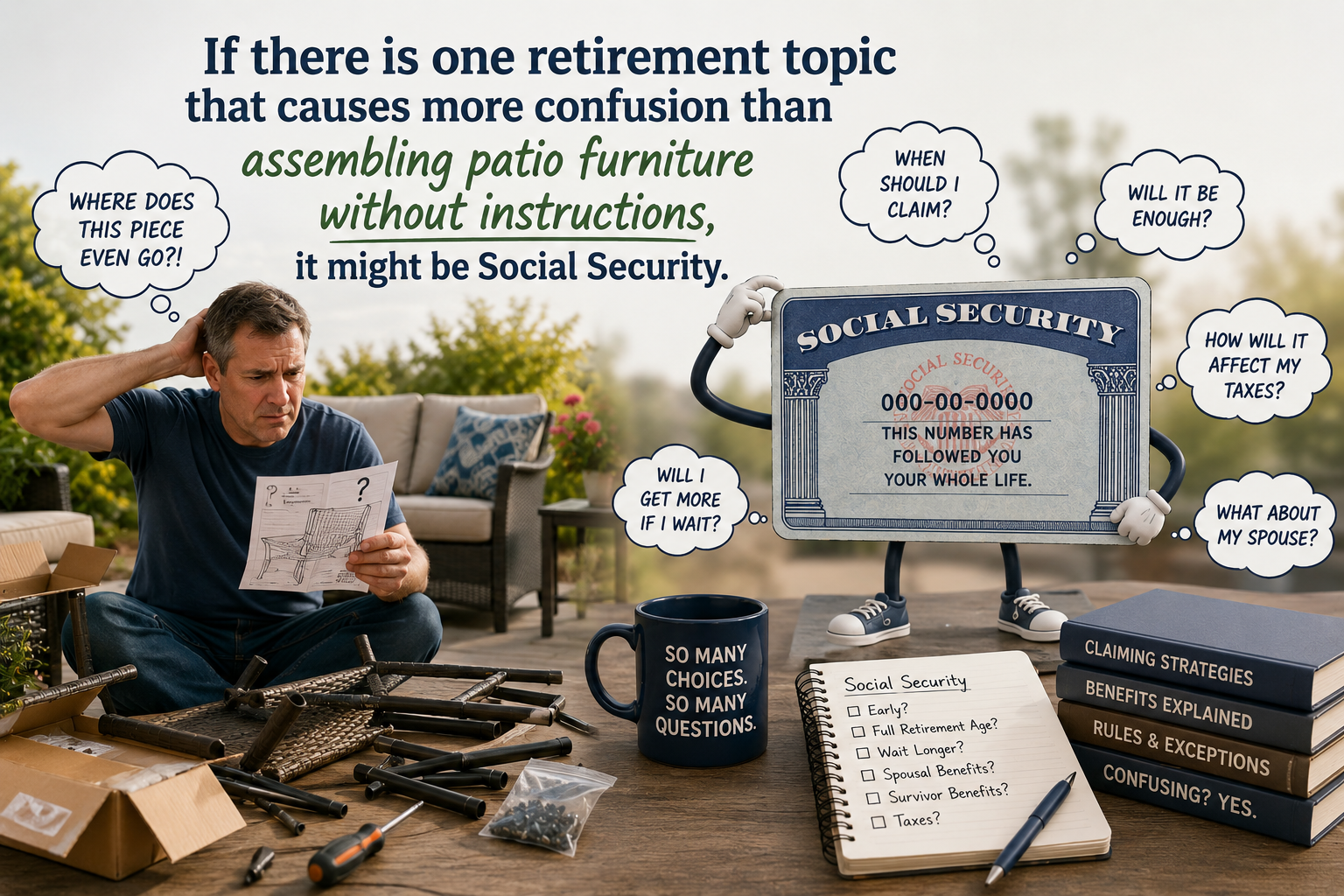
If there is one retirement topic that causes more confusion than assembling patio furniture without instructions, it might be Social Security!
People often ask:
Should I take it at 62?
Should I wait until 67?
Should I hold out until 70?
What happens if I remarry?
Can I still work?
Can my spouse collect on my record?
The answer to most Social Security questions is the same frustrating phrase every CPA and financial professional uses at some point:
“It depends.”
But let’s break down some of the biggest rules in plain English.
Why the Age You Claim Matters
One of the biggest Social Security decisions you make is when to start collecting benefits.
Generally speaking:
- Claiming at age 62 means taking a permanently reduced benefit
- Claiming at your Full Retirement Age (FRA) — often around age 66 to 67, depending on birth year — gives you your standard benefit
- Waiting until age 70 increases your monthly benefit through delayed retirement credits
For many people, waiting can significantly increase their monthly income. Current Social Security rules increase benefits approximately 8% per year after FRA until age 70.
But bigger is not always better.
Sometimes taking benefits earlier makes sense:
- Health concerns
- Limited life expectancy
- Immediate income needs
- Job loss or inability to continue working
On the other hand, delaying benefits can help:
- Higher earners in a married couple
- Individuals with longevity in the family
- People who have other retirement savings available
One important point many people miss:
When one spouse dies, the surviving spouse generally keeps the larger of the two Social Security checks — not both.
That means the higher earner’s claiming decision can affect the surviving spouse for decades.
Spousal Benefits: Yes, Your Spouse May Be Eligible
Married individuals may qualify for spousal benefits based on their spouse’s work record.
In general:
- A spouse may receive up to 50% of the other spouse’s full retirement benefit if claimed at full retirement age
- Claiming spousal benefits early can reduce the amount permanently
- You generally receive either your own benefit or the spousal amount — whichever is higher — not both added together
Divorced spouses may also qualify if:
- The marriage lasted at least 10 years
- The individual is currently unmarried
- Other Social Security eligibility requirements are met
This is an area where timing matters tremendously, and even small differences in age or filing status can change the outcome.
Remarriage Can Change Survivor Benefits
Now here’s a Social Security rule that surprises many people.
If someone is receiving or eligible for survivor benefits from a deceased spouse, remarriage can affect those benefits depending on when the remarriage occurs.
Under current Social Security rules:
- Remarrying before age 60 generally ends eligibility for survivor benefits on a deceased spouse’s record
- Remarrying at age 60 or later generally preserves eligibility for survivor benefits
There are also special rules for disabled widows and widowers, where the cutoff age may be 50 instead of 60.
And yes — divorced surviving spouses may qualify too if the prior marriage lasted at least 10 years.
This is one of those situations where a birthday can have enormous financial consequences.
Working While Collecting Social Security
A very common misconception is:
“If I work after claiming Social Security, I lose my benefits forever.”
That is not entirely true.
Before Full Retirement Age, Social Security applies an earnings test.
For 2025:
- Benefits are reduced by $1 for every $2 earned above the annual limit before FRA
- In the year you reach FRA, a different higher limit applies, and the reduction becomes $1 for every $3 above the limit
- Once you reach Full Retirement Age, the earnings limit disappears
Importantly:
The Social Security Administration later recalculates benefits to give credit for months where benefits were withheld.
Also important:
Only earned income counts toward the earnings test.
Generally, these do NOT count:
- Investment income
- Pension income
- IRA withdrawals
- 401(k) distributions
- Rental income
Only wages and self-employment income typically apply to the earnings test.
A Few Things People Often Forget
Social Security is not one-size-fits-all.
Factors that matter include:
- Health
- Marital status
- Age differences between spouses
- Retirement savings
- Employment plans
- Survivor planning
- Taxes
- Longevity expectations
And while Social Security feels simple on the surface, the rules underneath can become surprisingly complex.
Final Thoughts From Your Trusted CPA
Social Security is one of the few financial decisions where timing can affect your income for the rest of your life.
The good news?
You do not have to figure it all out alone.
The above post is intended as a general overview of Social Security rules and is provided for informational purposes only. Social Security laws and earnings limits can change, and individual circumstances vary greatly. Before making decisions regarding claiming strategies, survivor benefits, remarriage, or retirement income planning, you should consult with the Social Security Administration, your attorney, financial advisor, and CPA to discuss your personal situation.
Well, that’s all for today. I hope you learned a little something from your trusted CPA.
Dr. Donna Viens, CPA, CMA, CGMA


